Official signs via NNWI.org — the only NNW-approved vendor
501(c)(3) Nonprofit Organization
SAM.gov active · UEI KCRVWYMLDU28
Governance-First Architecture
NNWI.ai is a 501(c)(3) nonprofit platform that helps agencies educate, coordinate, and strengthen Neighborhood Watch programs — one trusted source of truth for training, roles, meetings, and approved materials. Bringing Neighborhood Watch into the modern era, without changing what makes it trusted.
Start with a custom handbook: one-click education grounded in local crime statistics and official Neighborhood Watch principles — a public preview of what NNWI.ai makes possible inside the agency portal.
Provides official guidance, approves materials, sets expectations
Organizes and educates the community to agency standards
The bridge between the agency and neighborhood groups
Organizes a street or block, welcomes and informs participants
Learns the principles, observes and reports through proper channels
A system by which a verified public-safety agency can govern otherwise independent resident Neighborhood Watch groups, conduct structured meetings with them, preserve consent and authority boundaries, turn those meetings into verifiable official records, and produce auditable evidence of the agency/community activity without converting residents into agency actors.
Neighborhood Watch has always depended on education, coordination, trust, and clearly defined roles. But in many communities the program becomes inconsistent, outdated, informal, or underused — not because the model failed, but because agencies lack modern tools to manage training, distribute official materials, coordinate participants, and keep everyone aligned.
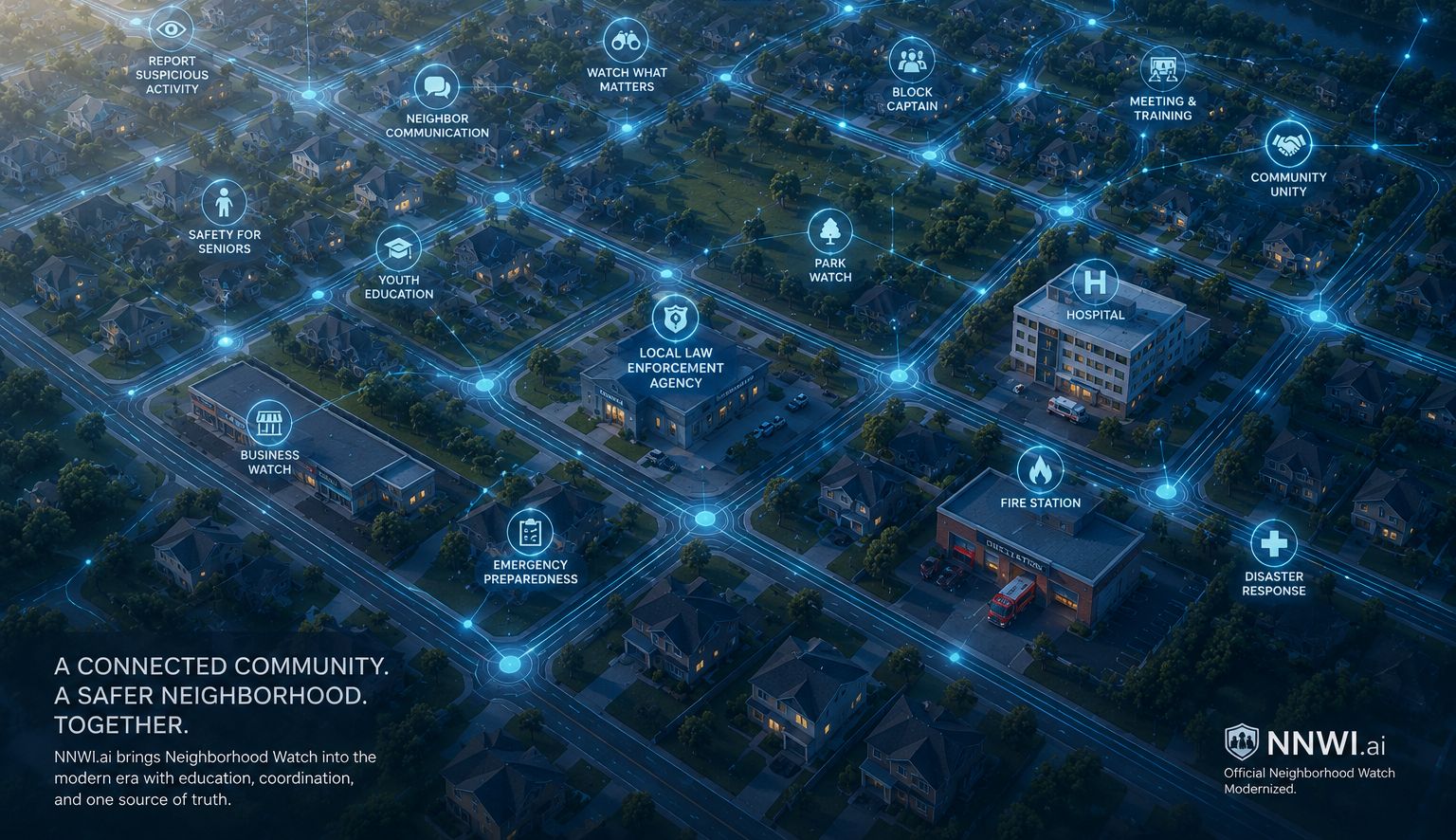
NNWI.ai solves this by becoming the official digital home for a Neighborhood Watch program. It brings the long-standing model into the modern era without turning it into a social network, a surveillance system, or a predictive policing tool.
The agency remains the trusted authority. NNWI.ai supports agency communication — it does not replace it.
Explore the Program EcosystemTeach the principles already found in official Neighborhood Watch handbooks — what the program is, what it is not, how to observe and report, and how to build trust between residents and agencies.
Publish official guidance, share approved materials, train coordinators and volunteers, and keep meetings organized — across every neighborhood or group the agency supports.
When agencies, coordinators, block captains, and residents all work from the same approved information, the program becomes safer, clearer, more consistent, and more effective.
NNWI.ai helps agencies teach the principles already found in official Neighborhood Watch handbooks and training materials — grounded in the long-standing model, not a new app trying to reinvent public safety.

What Neighborhood Watch is — and just as clearly, what it is not.
How to observe and report suspicious activity through proper channels.
How to communicate with law enforcement — the right information, the right way.
How to organize a block or neighborhood and keep it participating.
Prevention through awareness and neighbor-to-neighbor cooperation.
How to avoid vigilantism, confrontation, profiling, and rumors — explicitly taught, not assumed.
How to build trust between residents and their agencies.
How to keep information consistent and accurate across the whole program.
Role clarity — every participant knows what their role is and where it ends.
Before an agency launches a full portal, NNWI.ai can show the value immediately: a custom Neighborhood Watch handbook built around local crime statistics, education topics, and official program principles. It gives residents and coordinators a practical introduction to the same structured education model that powers the full NNWI.ai platform.
Free for residents and agencies. This is a preview of the structured education system available inside the NNWI.ai agency portal.
Start-up kits, block maps, and reporting worksheets — the practical paper tools that keep a watch group organized, free to download.
Get the Free WorksheetsAgencies equip their programs with official Neighborhood Watch signage through NNWI.org — the only NNW-approved vendor for these signs, and the visible backbone of an active watch program.
Boris the Burglar, the Boris the Burglar Logo, and the National Neighborhood Watch Logo are marks owned by the National Sheriffs’ Association. They may only be used under a license agreement with NSA — NNWI.org holds that license. A sign that carries these marks without one is not an official Neighborhood Watch sign.
Buy Official SignsOutdated documents, forwarded PDFs, and informal message threads pull a program apart. NNWI.ai gives agencies, coordinators, block captains, and residents one trusted, current home for official program information:
When everyone works from the same approved information, the program becomes safer, clearer, more consistent, and more effective.
An official Neighborhood Watch program works because each role is clear about what it does — and what it doesn't. NNWI.ai is built around these roles.
Most agencies run Neighborhood Watch with outdated documents, email chains, PDFs, and informal messaging. Guidance drifts. Materials go stale. New coordinators start from scratch.
NNWI.ai gives the agency a simple way to run its official program: publish guidance once, keep materials current everywhere, and support every neighborhood group from one place.
NNWI.ai supports agency communication — it does not replace it. Official information stays official, because it comes from the agency.
NNWI.ai is not a social feed, not a rumor board, not a surveillance tool, not predictive policing, and not autonomous law enforcement. It is a structured education and coordination platform for official Neighborhood Watch programs — and it does not replace the judgment of law enforcement or public officials.
Neighborhood Watch remains valuable because of what it has always been built on:
The problem is not that Neighborhood Watch is outdated. The problem is that many programs are still managed with outdated tools. NNWI.ai is the modern infrastructure that makes the official program easier to teach, manage, and sustain — so agencies can strengthen Neighborhood Watch instead of letting it fade.
These are the conditions we keep finding in the field. They are not a criticism of any department — they are what happens when a program built in 1972 is still run with a clipboard, a mailing list, and whoever happens to be in the seat.
Are there Neighborhood Watch or HOA groups active in your jurisdiction right now that your department has never registered, and never sat down with?
When a crime prevention volunteer tells a room what the police department recommends, is that coming from your department — or from that person?
If the officer holding this assignment moved on next month, would anyone know who the block captains are, or when the groups last met?
When an HOA board changes, does the Watch group survive the change, or does it quietly start over?
How many different Neighborhood Watch sign designs are posted across your city today — and which one is actually yours?
If a grant reviewer or your chief asked what your Watch program did last year, could you show a record of who met, what was decided, and what followed?
Independent groups are not the enemy of a Neighborhood Watch program — they are the program, waiting to be connected to it. A group nobody registered has no roster, no continuity, and no record. The fix is not to shut it down. The fix is to bring it under the agency it should have been partnered with from the start, and to keep one authoritative version of the program’s guidance, its materials, and its sign.
Everything above runs on a governed platform built for agencies. These are capabilities in service of education and coordination — not the product identity.
Meetings are one capability inside the platform — and they're built for program continuity, not video for its own sake. Your agency holds the meeting on NNWI hardware you control. We transcribe it and draft the summary locally — no public cloud, no third-party meeting service. Then a human on your side reviews and authorizes it. What you keep is a tamper-evident, hash-verified governed record, delivered to your agency's private workspace.
Audio is captured and processed on your own NNWI box over an encrypted connection. The recording never leaves your hardware.
A local model transcribes the meeting and proposes a structured summary, decisions, and action items — entirely on-premises.
Nothing becomes an official record until a human on your side approves it. The result is hash-locked, audit-stamped, and preserved.
Block-captain coordination meeting for the neighborhood watch program. The group reviewed upcoming patrol coverage, confirmed new signage placement, and walked through the fillable reporting worksheets captains will use and submit going forward.
Sample governed record. Every authorized output carries its source SHA-256, the human approver, and PII-review status — the tamper-evident audit trail that grant reviewers and oversight bodies require. Raw transcripts are never overwritten; records are superseded, never deleted.
NNWI.ai is designed for the public safety organizations where documentation gaps create real operational and legal risk.
Sheriff's offices, police departments, and task forces coordinating with neighborhood watch programs need meeting records that survive audit and oversight review.
Community coordinators running active watch programs need a system that maintains continuity across leadership changes and documents program activity for reporting.
Program managers responsible for grant compliance need documentation that supports audit-ready records without creating additional administrative burden.
NNWI.ai doesn't ask funders to trust that our platform works. We show them the records. Every governed meeting produces a tamper-evident, hash-linked output — documentation aligned with the evidence practices NIJ CrimeSolutions evaluators look for when rating an intervention as Effective.
View Grant PathwayPrimary federal target — $250K–$1M+ phased national rollout pathway
Community policing, technology, and innovation programs
Community resilience and preparedness infrastructure
Evidence-based intervention evaluation and CrimeSolutions rating
The work has been done. What NNWI.ai needs now is departments willing to tell us what is actually true in their jurisdiction — so the platform is shaped by real conditions instead of our assumptions about them. Phase 1 pilots are also how the audit trails get produced: every governed meeting record is evidence that these programs work, and that evidence does not exist today at any scale.
We work with a small number of agencies in each phase to keep governance quality high. There is no cost to participate. Tell us about your agency and we'll schedule an intake conversation to determine fit, requirements, and next steps.